
Community, Cultural, and Developmental Program
Expanding psychology’s reach through the integration of community, culture, and development.
The Community, Cultural, and Developmental (CCD) program emphasizes understanding the development of children and adults within their social and cultural contexts. This includes the advancement of theory and social action. To achieve this, we focus on the use of strengths-based approaches that promote inclusion and social justice, and apply a developmental perspective to understand stability and change in the life course.
Although our program has a similar philosophy to other community and developmental programs throughout the country, we include the systematic integration of cultural psychology in coursework and research. Consistent with this integration is the belief that the skills people develop, the interpersonal relationships they form, and the organizations and settings in which people participate are so interwoven that human behavior is best understood as part of its social and cultural fabric.
Other innovative features of the program include equal emphasis on qualitative and quantitative methodologies in course requirements, research projects, and practice. All of these features are designed to support the integration of community, cultural, and developmental principles and values.
For example, students in our program are cross-trained in developmental change in social behavior, cognition, language, and emotions through adulthood, as well as the foundations of community psychology. Our research is guided by a cultural-developmental perspective and focuses on how the interaction between individual attributes and environmental influences shape human development and psychological well-being. Students will work with their graduate advisor to identify a focal area for their studies (either community or developmental psychology).
Our program also has a Cooperative Agreement with the graduate program in cross-cultural psychology at the University of Victoria in Wellington, New Zealand. This Agreement facilitates student exchanges with opportunities for courses, research, and practice. Students who complete at least a semester of graduate work at the University of Victoria receive a Certificate recognizing their work at graduation.
Community, Cultural, and Developmental Curriculum
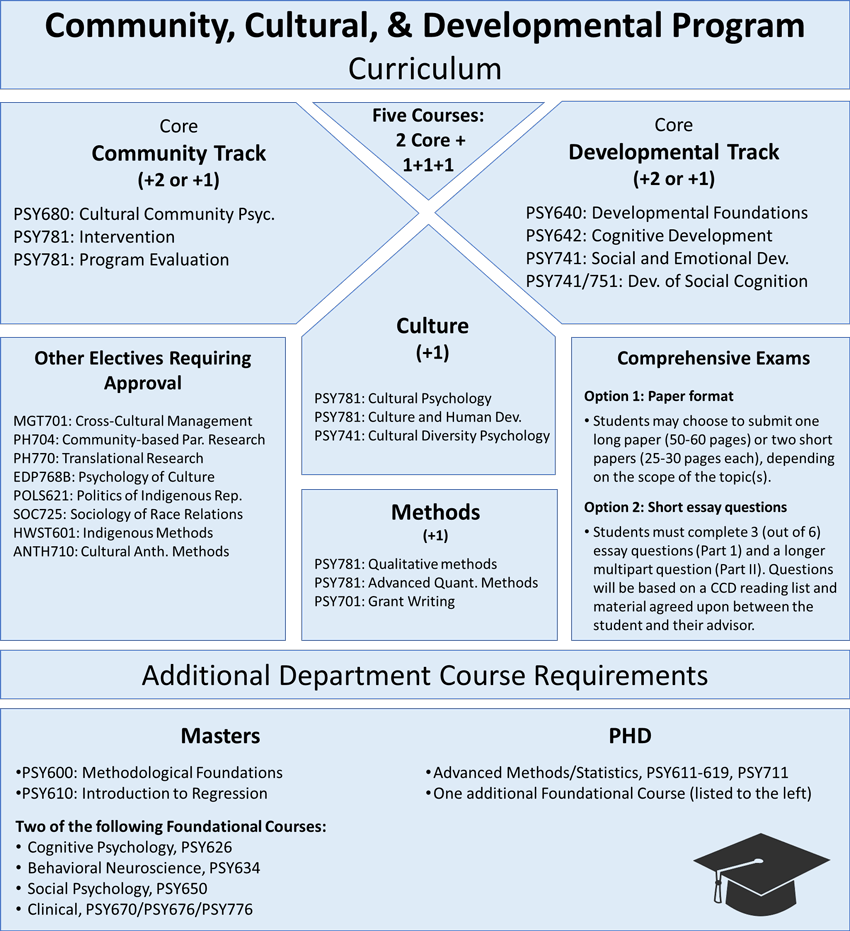
Students are required to work with their advisors to designate one core cluster (either core Cluster 1 or 2, see below) as the primary cluster. Students are expected to take at least two courses from the selected primary core cluster, and at least one course from each of the other three non-primary clusters.
Core Cluster 1 (Community):
- PSY 680: Cultural Community Psychology
- PSY 781: Seminar in Community Psychology: Intervention
- PSY 781: Seminar in Community Psychology: Program Evaluation
Core Cluster 2 (Developmental):
- PSY 640: Developmental Foundations
- PSY 642: Cognitive Development
- PSY 741: Seminar in Developmental Psychology: Social and Emotional Development
- PSY 741/751: Seminar in Developmental/Social Psychology: Development of Social Cognition
Cluster 3:
- PSY781: Seminar in Community Psychology: Cultural Psychology
- PSY781: Seminar in Community Psychology: Culture and Human Development
- PSY741: Seminar in Developmental Psychology: Cultural Diversity and Ethnic Minority Psychology
Cluster 4:
- PSY 781: Seminar in Community Psychology: Qualitative methods
- PSY 781: Seminar in Community Psychology: Advanced Quantitative Research Methods
- PSY 701: Seminar in General Psychology: Grant Writing
Departmental Course Requirement
- Master level: PSY 600, PSY 610, and at least two foundation courses (please refer to the department MA requirement page for more details)
- PhD level: at least one additional foundation course; at least one additional statistics/methods course (please refer to department PhD requirement page for more details)
Comprehensive Exam
Students will have one year to complete comprehensive exam after defending their MA theses and before proposing their dissertation. Three readers from the CCD Program (core or affiliate faculty) are required to evaluate the comprehensive exam.
Two formats of comprehensive exam:
Paper format: in consultation with their advisors, students may choose to submit either:
- One long paper (50-60 pages) or
- Two short papers (25-30 pages each), depending on the scope of the topic(s).
- The paper(s) should be in the form of a final submission rather than a draft.
Essay question format:
- Requires the completion of 3 (out of 6) essay questions (Part 1) and a longer multipart question (Part II). Questions will be based on material presented in the CCD graduate courses, the CCD reading list related to one of the four clusters of core curriculum, and materials mutually agreed upon between the student and their advisor.
Comprehensive Examination Grading and Procedures
Option 1: Paper(s) will be read and evaluated as “pass” or “fail” by three readers from the CCD Program (core or affiliate faculty). One faculty member must be the student's research advisor. The other faculty members will be asked to join after the student and the advisor discuss who might be the best match for the topic(s). If a paper is judged to be a “fail,” by any faculty member, the student will have one opportunity to submit a revision within six weeks. The student may seek comments from or consult with faculty members after receiving a “fail.” However, students may not request or receive comments on preliminary drafts of comprehensive examination papers prior to submitting them for pass/fail evaluation.
Option 2: A committee of three faculty readers will be formed to include the student's advisor and two other core or affiliate members. The exam must be completed without consultation on the content with anyone else. The comprehensive exam is taken after admission to the doctoral program and the completion of most courses, and before a dissertation committee is formed. The CCD program administers the exam twice during the academic year, typically on the first three-day weekend of each semester. Students should notify their advisor the semester prior to the semester they plan to take the exam.
Students have 4 days to complete the open-book, take-home exam. The CCD director emails the questions Friday morning at 8am and students have until Monday afternoon at 5pm to write and submit responses. For Part I, each student selects three questions from a list of six, prepared by the CCD faculty. Part II is comprised of one, multiple part question. Students have 4 days to complete the open-book, take-home exam, beginning Friday morning at 8am through Monday afternoon at 5pm. The exam must be completed without consultation on the content with anyone else and must be in APA format.
Each question on the exam is graded by the CCD faculty members on a five-point scale (1-5) with an average grade of 3.0 required to pass. An exam with a grade below 3.0 is a failure. A failed exam may be revised and resubmitted for grading if it has (1) an average grade between 2.75 and 3.0 AND (2) if at least 2 of the 3 questions on Part I and Part II received an average grade of at least 3.0 The exam may only be revised once, based on oral feedback from the CCD faculty, and resubmitted for grading, providing that at least 2 of the 3 questions on Part I, and Part II received an average grade of at least 3.0. The revision must receive an average grade of at least 3.0 to pass. A failed exam with an average grade below 2.75 may be retaken once, with new questions, at the discretion of the CCD faculty. As passing the comprehensive exam is required by Graduate Division, failure shall result in dismissal from the graduate program.
Community, Cultural, & Developmental Example Schedule [Community Track]
| First Year – Fall | Degree Requirement |
|---|---|
| PSY 610: Introduction to Regression (Statistics Requirement 1) (3) | MA-GEN |
| PSY 680: Cultural Community Psychology (CCD Community Track 1) (3) | MA-CCD |
| PSY 600: Methodological Foundations of Psychology (Methods Requirement 1) (3) | MA-GEN |
| PSY 789: Community Psychology Research (3) | MA-GEN |
| First Year – Spring | Degree Requirement |
| PSY 640: Developmental Foundations (CCD Developmental Track 1) (3) | PHD-GEN |
| PSY 781: Culture & Human Development (CCD Culture 1) (3) | MA-CCD |
| PSY 619: Multilevel Modeling (Statistics Requirement 2) (3) | PHD-GEN |
| PSY 789: Community Psychology Research (3) | MA-CCD |
| Second Year – Fall | Degree Requirement |
| PSY 650: Social Psychology (Foundation Course 1) (3) | MA-GEN |
| PSY 781: Introduction to Qualitative Methods (CCD Methods 1) (3) | PHD-CCD |
| PSY 682 Practicum (3) | PHD-CCD |
| PSY 700: Thesis (proposal) (3) | MA-GEN |
| Second Year - Spring | Degree Requirement |
| PSY 781: Community Interventions (CCD Community Track 2) (3) | PHD-CCD |
| PSY 781: Advanced Quantitative Research Methods (CCD Methods 2, Elective) (3) | PHD-CCD |
| PSY 700: Thesis (defense) (3) | MA-GEN |
| Third Year – Fall | Degree Requirement |
| PSY 781: Cultural Psychology (CCD Culture 2, Elective) (3) | PHD-CCD |
| PSY 670: Introduction to Clinical Psychology (Foundation 3) (3) | PHD-GEN |
| PSY 789: Community Psychology Research (Comprehensive Exams Timeslot A) (3) | PHD-CCD |
| Third Year – Spring | Degree Requirement |
| PSY 781: Program Evaluation (CCD Community Track 3, Elective) (3) | PHD-CCD |
| Other Elective (outside of the psychology department) (3) | PHD-GEN |
| PSY 789: Community Psychology Research (Comprehensive Exams Timeslot B) (3) | PHD-CCD |
| Fourth Year – Fall | Degree Requirement |
| PSY 800 Dissertation Proposal (3) | PHD-GEN |
| Fourth Year - Spring | Degree Requirement |
| PSY 800: Dissertation Defense (3) | PHD-GEN |
Community, Cultural, & Developmental Example Schedule [Developmental Track]
| First Year – Fall | Degree Requirement |
|---|---|
| PSY 610: Introduction to Regression (Statistics Requirement 1) (3) | MA-GEN |
| PSY 680: Cultural Community Psychology (CCD Community Track 1) (3) | MA-CCD |
| PSY 626: Cognitive Psychology (Foundation Course 1) (3) | MA-GEN |
| PSY 749: Developmental Psychology Research (3) | MA-GEN |
| First Year – Spring | Degree Requirement |
| PSY 600: Methodological Foundations of Psychology (Methods Requirement 1) (3) | MA-GEN |
| PSY 781: Culture & Human Development (CCD Culture 1) (3) | MA-CCD |
| PSY 640: Developmental Foundations (CCD Developmental Track 1) (3) | PHD-GEN |
| PSY 749: Developmental Psychology Research (3) | MA-CCD |
| Second Year – Fall | Degree Requirement |
| PSY 619: Multilevel Modeling (Statistics Requirement 2) (3) | PHD-GEN |
| PSY 781: Introduction to Qualitative Methods (CCD Methods 1) (3) | PHD-CCD |
| PSY 682 Practicum (3) | PHD-CCD |
| PSY 700: Thesis (proposal) (3) | MA-GEN |
| Second Year - Spring | Degree Requirement |
| PSY 642: Cognitive Development (CCD Developmental Track 2) (3) | PHD-CCD |
| PSY 781: Advanced Quantitative Research Methods (CCD Methods 2, Elective) (3) | PHD-CCD |
| PSY 700: Thesis (defense) (3) | MA-GEN |
| Third Year – Fall | Degree Requirement |
| PSY 781: Cultural Psychology (CCD Culture 2, Elective) (3) | PHD-CCD |
| PSY 634: Behavioral Neuroscience (Foundation 3) (3) | PHD-GEN |
| PSY 749: Developmental Psychology Research (Comprehensive Exams Timeslot A) (3) | PHD-CCD |
| Third Year – Spring | Degree Requirement |
| PSY 781: Program Evaluation (CCD Community Track 3, Elective) (3) | PHD-CCD |
| Other Elective (outside of the psychology department) (3) | PHD-GEN |
| PSY 749: Developmental Psychology Research (Comprehensive Exams Timeslot B) (3) | PHD-CCD |
| Fourth Year – Fall | Degree Requirement |
| PSY 800 Dissertation Proposal (3) | PHD-GEN |
| Fourth Year - Spring | Degree Requirement |
| PSY 800: Dissertation Defense (3) | PHD-GEN |

Program Area Faculty:
Affiliate Faculty
- Dharm Bhawuk
- Kristin Pauker
Emeritus Faculty
- Anthony Marsella
- Clifford R. O'Donnell
- Roland G. Tharp
- Catherine Sophian